The Physics of Microwaves: Simulating Crystal Structures
Rodney Stadum—son of Palmer and Signe—pursued a career in science and education that diverged from his sisters' focus on public school instruction and social history. His 1973 contribution to undergraduate physics education highlights the family's shared dedication to making knowledge accessible and tangible.
In January 1973, Rodney co-authored a brief but significant paper titled *Bragg Diffraction of Microwaves* in the *American Journal of Physics* (AJP). His co-author was Thomas D. Rossing, a distinguished physicist and acoustics expert who taught for decades at Northern Illinois University and later Stanford University. The article addressed a practical challenge in physics education: how to demonstrate the abstract principles of wave diffraction and crystal lattices to undergraduate students without requiring expensive or hazardous X-ray equipment. X-ray diffraction, discovered by Max von Laue and formulated by William Lawrence Bragg, is the primary method used to determine the atomic structure of crystals. However, because X-rays have extremely short wavelengths (on the order of 0.1 nanometers), the experiments are difficult to visualize directly.
The Microwave Analog Experiment
To overcome this, Rodney and Rossing designed an elegant analog experiment using electromagnetic radiation in the microwave range. Microwaves have wavelengths in the centimeter range (typically around 3 cm for standard 10-GHz laboratory transmitters). Because these waves are much larger than X-rays, the "crystal lattice" used to diffract them can also be scaled up. Instead of a microscopic crystal of salt, Rodney and Rossing constructed an artificial crystal lattice using ordinary materials, such as an array of metal spheres or rods embedded in Styrofoam sheets. By transmitting microwaves at this macroscopic lattice and rotating it, students could measure the angles of constructive interference where the reflected waves reinforced each other, directly verifying Bragg's Law: $2d \sin\theta = n\lambda$.
The paper detailed how to build and align this apparatus using standard classroom microwave transmitters and receivers. By providing a clear, step-by-step layout for this experiment, Rodney and his co-author made it possible for colleges and universities nationwide to introduce hands-on wave physics labs that were safe, affordable, and visually intuitive. This focus on practical demonstration echoed his father Palmer's mechanical and electrical ingenuity, transforming abstract mathematical formulas into physical, measurable phenomena.
Midwestern Career and Family Ties
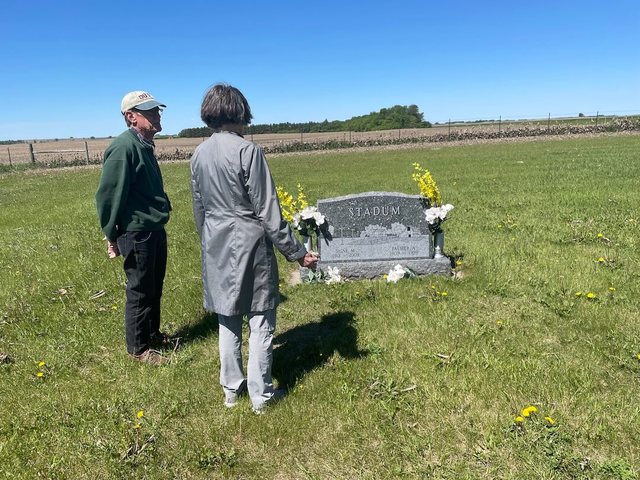
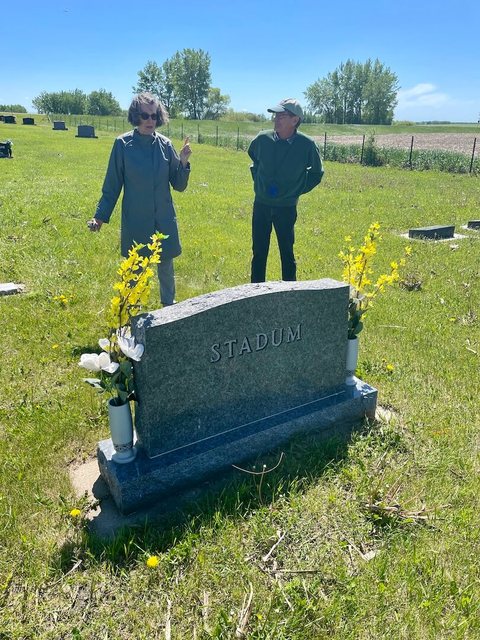
Following his academic work, Rodney established his professional career in the Midwest. He eventually settled in Dayton, Ohio, an industrial and technological center known for its history of aviation and engineering. In Dayton, Rodney built a life with his wife, Chris Stadum. Despite living hundreds of miles from the North Dakota farm country where his parents resided, Rodney maintained close ties to his siblings, Peggy and Beverly. The family archive preserves photographs of Rodney visiting Saint Petri Cemetery near York, North Dakota, standing alongside Beverly at the grave markers of Palmer and Signe. These visits represent the ongoing connection of the second-generation siblings to their ancestral geography. Through his contributions to physics pedagogy, his professional career in Ohio, and his participation in family preservation efforts, Rodney has carried the Stadum family's legacy of intellectual curiosity and practical care into the scientific realm.